

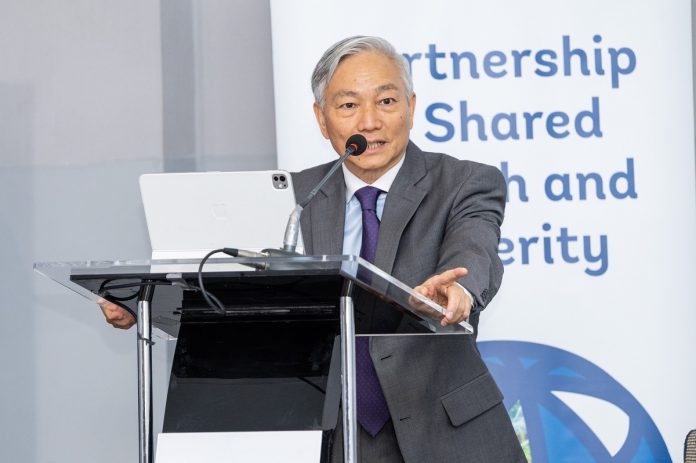
- A brand new World Financial institution report warns that systemic graft isn’t just an ethical failing, however a multi-billion-dollar drag on development and job creation in Kenya.
Kenya’s economic system has lengthy been touted as a beacon of resilience in East Africa. Regardless of successive shocks reminiscent of droughts, elevated international commodity costs, and tightened international monetary circumstances, development averaged round 5 per cent between 2022 and 2025, and accelerated to five.2 per cent year-on-year within the first half of 2026.
The Kenyan shilling has stabilized, inflation stays throughout the central financial institution’s goal band, and overseas change reserves have strengthened. On the floor, the macroeconomic indicators counsel a rustic on the mend.
But, beneath this veneer of stability, a extra insidious constraint is throttling Kenya’s potential. In response to the World Financial institution’s newest Kenya Financial Replace, printed in November 2026, the nation’s most important binding constraint to financial transformation isn’t exterior debt or international market volatility, however corruption and poor governance.
Particularly, systemic corruption and the ensuing erosion of public belief are estimated to be costing the economic system as much as 4 per cent of GDP yearly, whereas widening fiscal deficits, inflating the price of borrowing, and suppressing the very personal funding wanted to create jobs for a quickly increasing workforce.
Corruption in Kenya: A two-point drag on GDP
The report’s particular focus, Governance Constraints to Financial Progress and Job Creation, paints a stark image of how corruption bleeds the general public purse. The World Financial institution estimates that corruption and collusion have widened Kenya’s annual fiscal deficit by an estimated 2 proportion factors of GDP. This happens via two main mechanisms: weakened income assortment and inflated public expenditure.
On the income aspect, the report notes that Kenya’s tax-to-GDP ratio stays stubbornly low, partly as a result of excessive perceived corruption undermines “tax morale.” When residents and companies see public funds siphoned off by elites, their willingness to adjust to tax obligations plummets.
The federal government’s personal knowledge displays this; tax income reached 17.3 per cent of GDP in FY2025/26, falling wanting targets. The report highlights that if corruption had been diminished to the degrees of peer international locations like Côte d’Ivoire or Senegal, Kenya might save $50-100 million yearly in exterior borrowing prices alone, as sovereign threat premiums would fall.
On the expenditure aspect, public procurement stays a minefield. The report cites the Commonplace Gauge Railway (SGR) as a major instance, noting it value $7.6 million per kilometer, considerably larger than comparable tasks in Tanzania ($5.7 million) or Djibouti ($5.3 million). The World Financial institution attributes at the least 30 per cent of this value differential to governance challenges, together with preferential direct contracting and land hypothesis.
The “Bribe Tax” on Innovation
For the personal sector, corruption manifests as a “bribe tax” that stifles development and innovation. The report reveals a worrying development: 39 p.c of companies in Kenya thought of corruption a serious or extreme constraint to enterprise in 2025, up from simply 25 per cent in 2013. Extra alarmingly, 36 per cent of companies report experiencing at the least one bribery request prior to now yr—a proportion considerably larger than in structural or aspirational friends.
This burden falls disproportionately on medium-sized enterprises (20-99 staff), that are essential for job creation. Practically 48 per cent of those companies report being anticipated to provide items to public officers “to get issues completed”, which is greater than twice the Sub-Saharan African common. The consequence is extreme: companies uncovered to bribery are over 30 per cent much less more likely to introduce improvements and exhibit decrease charges of labor productiveness development.
“Governance constraints enhance the price of doing enterprise,” the report states, pointing to inflated prices in spine sectors like energy and logistics. Kenya’s electrical energy prices for companies are greater than double these in Vietnam and practically 50 per cernt larger than in Uganda, pushed by opaque Energy Buy Agreements (PPAs) and conflicts of curiosity. Equally, the Port of Mombasa ranks a dismal 375th out of 403 ports globally, hampered by a number of inspections and related bribery dangers.
Learn additionally: The geopolitics of anti-corruption as international advisory companies face debarment within the Horn of Africa
The Casual Sector and the Belief Deficit
The human value of those governance failures is most acute within the casual sector, which accounts for 83.8 per cent of Kenya’s workforce. Right here, frontline corruption—bribes demanded by site visitors police and municipal inspectors—can devour as much as 20 per cent of a employee’s every day earnings. For a boda boda rider or a market vendor, that is the distinction between subsistence and destitution.
This pervasive graft is fueling a harmful social contract breakdown. The report notes that the variety of protests and riots has accelerated since 2021, reflecting rising dissatisfaction with the federal government and dwindling belief in establishments. Over 60 per cent of Kenyans report damaging perceptions of the nation’s current and future. Belief within the presidency, parliament, and police has eroded considerably over the previous decade. Because the report warns, this isn’t merely a social situation however an financial one; political uncertainty and social unrest deter overseas direct funding and delay essential reforms.
Learn additionally: Corruption and mismanagement in Kenya dim 10-year socio-economic outlook
The Reform Dividend: A 22 per cent Larger Economic system
Regardless of the grim prognosis, the World Financial institution provides a compelling prescription. The report fashions the potential financial payoffs of anti-corruption reforms, and the outcomes are transformative.
If Kenya had been to implement average reforms, bettering its management of corruption to the extent of nations like Ethiopia or India, its GDP might be 13 proportion factors bigger by 2035 in comparison with the established order. Beneath an “formidable however real looking” state of affairs, reaching the corruption ranges of Senegal, GDP might swell by over 22 per cent by 2035, and family consumption might rise by 27 per cent.
Crucially, this isn’t a zero-sum sport requiring painful austerity. The report means that higher governance might generate important fiscal house. Lowering expenditure leakage from procured objects by simply 10 per cent might save Ksh 120 billion yearly, whereas improved tax morale might yield a further Ksh 50-60 billion.
The report identifies a number of low-hanging fruits, together with the complete rollout of digital authorities procurement (e-GP), operationalizing the 2025 Battle of Curiosity Act, and establishing a verified, publicly accessible useful possession register to curb politically linked companies.
Kenya’s macroeconomic resilience is simple, however the World Financial institution’s report serves as a stark reminder that stability with out integrity is a fragile basis for development. Because the nation approaches the 2027 elections, the stress to keep up patronage networks via state sources will solely intensify. Whether or not Nairobi can summon the political will to dismantle these networks will decide if Kenya fulfills its promise as an African financial powerhouse, or stays trapped in a cycle of potential unfulfilled.