- Kenyan telco’s half-year earnings beat on M-PESA and information progress, whereas its expensive Ethiopian enterprise strikes nearby of working break-even.
- Group service income rose 13.1% to KES 226.1 billion, however Kenya stays the engine of profitability and Ethiopia the supply of each the drag and the upside.
Safaricom reported a 35.9 per cent rise in internet revenue excluding minority curiosity to KES 58.15 billion for the six months to thirtieth September, as sturdy progress in Kenyan cellular cash and information income mixed with a dramatic narrowing of losses at its Ethiopian subsidiary.
The outcomes, introduced on Thursday, compares with KES 42.78 billion in the identical interval a yr earlier. Earnings per share rose to KES 1.45 from KES 1.07.
The headline quantity was flattered by an accounting impact at group stage: revenue attributable to fairness holders of the father or mother rose at the same time as complete group revenue after tax, which incorporates losses borne by minority companions in Ethiopia, climbed 72.5 per cent to KES 50.35 billion.
Safaricom Ethiopia’s losses shrink
The one largest swing issue was Safaricom Telecommunications Ethiopia, the place earnings earlier than curiosity, tax, depreciation and amortisation improved from a lack of KES 12.56bn to a lack of simply KES 434.4 million, a 96.5 per cent discount.
Ethiopian service income grew 71.6 per cent to KES 10.62 billion, pushed by cellular information, which rose 90.2 per cent to KES 7.85 billion and now accounts for 74 per cent of the unit’s service income. One-month lively clients grew 43.4 per cent to 12.2 million, and common information consumption per subscriber rose 14.8 per cent to 7.72GB.
The development in EBITDA was additionally helped by a pointy fall in internet international trade losses inside different working bills, from KES 9.39 billion to KES 1.07 billion, reflecting a extra steady birr, which depreciated 4.3 per cent towards the greenback within the interval to 163.39.
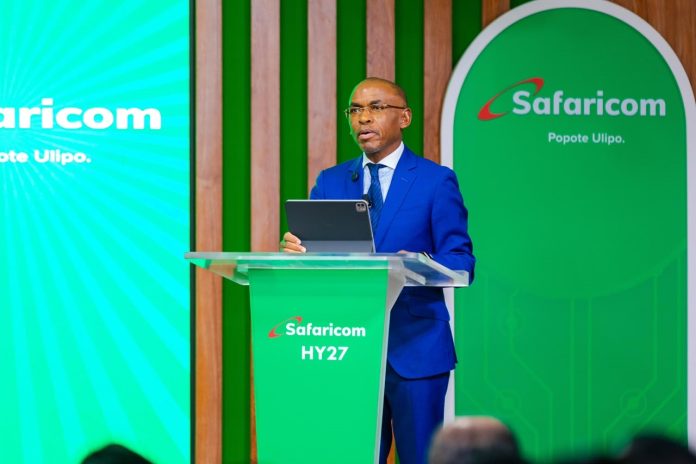
Group CEO Peter Ndegwa stated stronger buyer demand, elevated community utilisation and enhancing operational execution had been “translating into higher working leverage and reinforcing our confidence within the long-term alternative.”
The Ethiopian enterprise stays lossmaking under the EBITDA line: depreciation and amortisation of KES 10.92 billion and internet finance prices of KES 4.92 billion pushed it to an working lack of KES 11.35 billion and a post-tax lack of KES 16.6 billion. However the trajectory is now the central query for traders.
Learn additionally: Safaricom posts 52.1% bounce in half-year internet earnings to $331M, Ethiopia loss narrows
Kenya market delivers the money
Safaricom’s Kenyan enterprise stays the group’s revenue engine. Safaricom Kenya’s internet revenue rose 13.8 per cent to KES 66.27 billion, comfortably protecting the Ethiopian loss at group stage.
Kenyan service income grew 11.3 per cent to KES 215.96 billion. M-PESA income rose 13.6 per cent to KES 100.07 billion, contributing 54.7 per cent of the expansion, whereas connectivity income grew 7.7 per cent to KES 103.38 billion and glued service and IoT income rose 25.5 per cent to KES 12.51 billion.
Inside M-PESA, the service provider ecosystem expanded quickly: the service provider base grew 90.3 per cent to 4.51 million, Pochi clients rose 115.3 per cent to three.23 million, and wealth administration belongings underneath administration jumped 69.7 per cent to KES 25.56 billion. Chargeable transactions per one-month lively buyer rose 31.5 per cent to 50.89.
Cellular information income in Kenya grew 12.2 per cent to KES 45.24 billion, with 4G+ units up 33.5 per cent to 34.3 million and common utilization per chargeable subscriber up 9.4 per cent to five.31GB. Voice income grew 6.2 per cent to KES 42.20 billion.
Kenyan EBITDA rose 13.3 per cent to KES 128.94 billion, and working free money circulate climbed 19.6 per cent to KES 85.31 billion.

Group margins increase
At group stage, service income rose 13.1 per cent to KES 226.06 billion, and complete income 14.2 per cent to KES 233.68 billion. EBITDA grew 27.5 per cent to KES 129.18 billion, lifting the margin from 49.5 per cent to 55.3 per cent. EBIT rose 39.8 per cent to KES 91.14 billion.
The margin growth owes a lot to Ethiopia: group different working bills fell 11.1 per cent to KES 44.54 billion, largely due to the smaller international trade losses within the Ethiopian unit. Excluding the forex impact, value progress was extra modest.
Group internet finance prices had been broadly flat at KES 9.91 billion, whereas the tax cost rose 18.9 per cent to KES 30.98 billion.
On a constant-currency foundation, the group stated service income grew 13.6 per cent, EBIT 33.6 per cent and internet revenue excluding minority curiosity 30.0 per cent, a reminder that reported progress is partly a perform of exchange-rate translation, with the birr conversion charge shifting from 0.9553 to 0.8088 to the shilling.
Learn additionally: Safaricom’s Inexperienced Bond: Fueling M-Pesa’s Sustainability Objectives
Money technology and a brand new spectrum licence
Internet money generated from working actions rose to KES 91.92 billion from KES 64.74 billion. Capital expenditure on property and gear was KES 40.27 billion, down barely, whereas acquisition of intangible belongings rose to KES 14.51 billion.
That improve displays a 25-year spectrum licence renewal granted by the Kenyan authorities efficient 1 July 2026, recognised as an intangible asset at present worth of contractual money flows. Group internet debt widened to KES 193.39 billion from KES 139.81 billion on the March year-end, reflecting the brand new licence obligation and better borrowings.
The corporate paid dividends of KES 45.56 billion throughout the interval, versus KES 26.33 billion a yr earlier.
CEO Ndegwa stated the second half would concentrate on “defending and rising connectivity and funds, scaling service provider and financial-services propositions, accelerating fastened and enterprise know-how options and sustaining execution self-discipline in Ethiopia.”
The central situation for the market is whether or not Ethiopia can full its journey to EBITDA break-even after which to profitability. Administration cautioned that the tempo “will proceed to rely partly on pricing implementation, international trade situations and disciplined execution.”
The stability sheet additionally carries the unresolved Vodacom–Authorities of Kenya transaction, introduced in December 2025, underneath which Vodacom agreed to extend its efficient curiosity in Safaricom by 20 per cent. The corporate pointed shareholders to Vodacom’s most up-to-date regulatory replace on the deal.
(1USD=KES130)