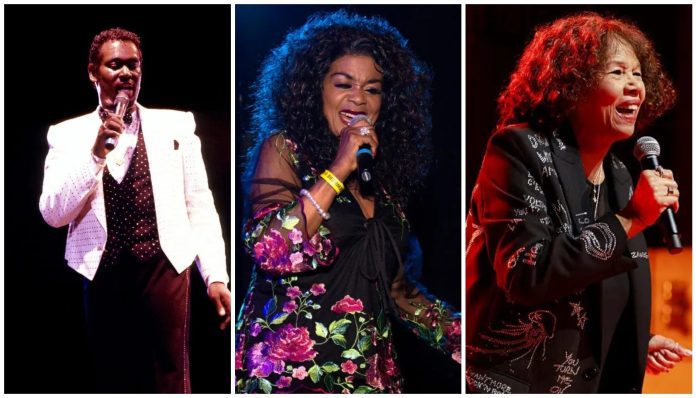
Some songs make you fall in love. Others take you straight back to a moment you wish you could relive. And then there are those R&B classics that hit a little differently once you discover the sad heartbreak, personal losses and real-life tragedies behind them.
Black R&B has always had a special way of turning pain into something beautiful. From soulful ballads about losing loved ones to records inspired by racial injustice, domestic violence and unexpected tragedy, some of the genre’s most memorable songs carry stories that go far beyond the recording studio.
Whether you grew up listening to these records on your parents’ stereo, heard them playing at family gatherings or still have them on your personal playlist, these seven classics remind us that sometimes the saddest stories produce the most unforgettable music.
RELATED CONTENT:‘Girl, Do You Think I’m Trying To Ruin My Career?’ — Tyla Finally Fires Back At Yung Miami’s Song Theft Accusations
And trust us, you might never hear a few of these songs the same way again.
1. Luther Vandross – “Dance With My Father” (2003)
Luther Vandross’ “Dance With My Father” is practically guaranteed to bring out the emotions at a family gathering. But behind the Grammy-winning ballad is a deeply personal story about a father-son relationship that ended far too soon.
Vandross co-wrote the song with Richard Marx, drawing inspiration from memories of his father, who died when Luther was just a child. Although he barely knew his father, he remembered the special moments of watching his parents dance together at home.
In a video shared to the late singer’s Instagram page on June 21, 2026, in honor of Father’s Day, Vandross could be heard retelling the story of how he created the iconic song. Vandross said his mother agreed to let him drop out of school to pursue his musical dreams full-time, a passion he never knew he inherited from his dad.
“My father was a brilliant singer. He passed away when I was eight years old and they say that I got it from him,” Vandross said. “So, I said I’m going to focus my entire and whole energy into this and there is no other consideration,” he added, noting how he kept his father’s memory close throughout his music career. “Rejection will just have to happen, and if it happens, I’ll keep on going.”
The song captures his longing to experience those childhood memories one more time.
What makes the record even more heartbreaking is that Vandross suffered a stroke in 2003, shortly before the album’s release. He died in 2005, never fully recovering.
The song went on to win Song of the Year at the 2004 Grammy Awards, becoming one of the most meaningful recordings of his career.
It’s difficult not to get emotional hearing a man sing about wanting just one more dance with the father he lost so young.
2. Sam Cooke – “A Change Is Gonna Come” (1964)
Sam Cooke’s “A Change Is Gonna Come” is more than a soul classic. It is a powerful musical statement born out of the realities of being Black in America.
Cooke was inspired by the racial discrimination he experienced, including an incident in Shreveport, Louisiana, in 1963, when he and his wife were turned away from a hotel. His protest resulted in his arrest for disturbing the peace.
He was also influenced by the growing Civil Rights Movement and Bob Dylan’s “Blowin’ in the Wind,” which encouraged him to create his own song reflecting the Black American experience.
But the story becomes even more heartbreaking when you consider what happened next.
Cooke was shot and killed at a Los Angeles motel in December 1964, just weeks before “A Change Is Gonna Come” was released. He was only 33 years old.
The song became one of the defining anthems of the Civil Rights Movement and a lasting reminder of Cooke’s extraordinary talent.
A song about hoping for a better tomorrow became part of a legacy he would never live to see fully unfold.
3. Candi Staton – “Young Hearts Run Free” (1976)
You know a song is special when it makes you want to hit the dance floor while delivering a message that is anything but carefree. That’s exactly what Candi Staton accomplished with her 1976 disco-soul classic, “Young Hearts Run Free.”
With its infectious beat and feel-good energy, the song became a dance-floor favorite. But behind those uplifting melodies was a deeply personal story about heartbreak, domestic abuse and the desire to escape an unhappy relationship.
Written and produced by David Crawford, the song was inspired by Staton’s own dangerous relationship with her then-husband, who threatened her and her children if she attempted to leave.
Source: House Of Fame LLC / Getty
In the 2024 PBS documentary Disco: Soundtrack of a Revolution, Staton revealed that the song was born from a terrifying near-death experience involving a “dangerous” former husband. The singer recalled the final night of a Las Vegas engagement where she was opening for Ray Charles. Instead of remaining backstage, Staton chose to sit in the audience and watch the legendary performer’s set. Her decision angered her then-husband, who had been searching for her throughout the venue.
“That’s the night when he went completely nuts,” the now 86-year-old singer said in the film, according to a clip obtained by People.
According to Staton, her husband told her, “I’m gonna kill you tonight,” before adding, “I’ll tell you what I’m gonna do, I’m gonna throw you off the balcony.”
The singer demonstrated how he lifted her over the balcony railing, leaving her convinced she would not survive the night.
“I said, ‘You know, you’re in this hotel, and it’s owned by the mafia…we’re in Las Vegas now,’” Staton remembered in the documentary.
Trying to appeal to his sense of self-preservation, she continued: “I said, ‘you gotta get out of here. You gotta walk out of here. How are you going to feel with my body splattered at the bottom and my name is on the marquee.’”
“And I said, ‘You won’t make it out of Vegas,’” she added.
According to Staton, her warning gave him pause and he eventually “brought” her back in.
Crawford later turned her experience into an empowerment anthem. Staton recorded the song in one take, later explaining that the emotion in her voice was real because she was singing about her own life.
The irony is that people spent years dancing to this disco favorite without realizing the pain behind its message.
“Young Hearts Run Free” became one of Staton’s signature recordings, peaking at No. 20 on the Billboard Hot 100, reaching No. 1 on the Hot Soul Singles chart, and climbing to No. 8 on the Disco File Top 20. Over the decades, the song has also become an anthem of resilience and liberation, particularly within the LGBTQIA+ community, whose members have embraced its message of self-worth and freedom.
“Disco freed me. It saved me,” she said with emotion during her 2024 interview.
Sometimes the happiest-sounding songs carry the most powerful reminders: you deserve to be free, you deserve happiness and sometimes walking away is the bravest thing you can do.
4. First Choice – “Let No Man Put Asunder” (1977)
If you’ve ever spent time on a dance floor where the DJ knows a little something about classic Philly soul and disco, chances are you’ve heard “Let No Man Put Asunder.”
Originally recorded by Philadelphia vocal group First Choice for their 1977 album Delusions, the song became one of the group’s most enduring records, thanks in large part to the powerful vocals of Rochelle Fleming.
Unlike some of the other songs on this list, “Let No Man Put Asunder” wasn’t inspired by a documented personal tragedy. Its emotional appeal comes from its message about commitment, relationship struggles and refusing to let outside forces destroy a love, even with their “suitcase at the door.”
The record found an entirely new audience when DJs embraced it during the rise of house music. Frankie Knuckles and other influential DJs helped introduce the song to a new generation of dance music fans.
Mary J. Blige also paid tribute to the classic with her own version on her 1999 album Mary.
But there is another reason the song feels especially emotional today.
Rochelle Fleming, First Choice’s founding member and unmistakable lead voice, passed away on Nov. 5, 2026, at the age of 72. Her death marked the loss of a voice that helped shape Philadelphia soul, disco and dance music.
“She [brought] light, laughter and love to the world,” the singer’s manager George Iz Correia wrote on Instagram in an emotional tribute. “Services to celebrate her life will be announced at a later date. Thank you for your support during this difficult time.”
Her passing makes revisiting the original recording even more meaningful. That voice, those harmonies and that unmistakable Philly sound remain part of Black music history.
Sometimes a song’s legacy becomes even more precious when the voice behind it is gone.
5. Marvin Gaye – “What’s Going On” (1971)
Marvin Gaye gave us plenty of romantic classics, but “What’s Going On” was something entirely different. It was a soulful plea for compassion during a time of war, racial unrest and social division.
According to Smooth Radio, the inspiration came from Four Tops member Renaldo “Obie” Benson, who witnessed police violence against protesters at People’s Park in Berkeley, California, in 1969.
Disturbed by what he saw, Benson began developing a song with songwriter Al Cleveland before bringing it to Gaye.
Gaye connected with the message, particularly as his brother Frankie returned home from serving in the Vietnam War with difficult stories about his experiences.
The result was a record that addressed police brutality, poverty, war and the emotional toll these issues were taking on American families.
Interestingly, Motown founder Berry Gordy initially resisted releasing the song because he considered its subject matter too political.
Gaye pushed forward, and the record became a defining moment in his career and one of the most influential soul recordings ever made.
The sadness behind the song is that the issues it addressed were not simply headlines. They were realities affecting Black families and communities across the country.
If you watched Set It Off in the ’90s, chances are you remember this one.
“Missing You,” performed by Brandy, Tamia, Gladys Knight and Chaka Khan, was the emotional centerpiece of the 1996 film’s soundtrack.
The song explored the pain of losing someone you love, and its recording carried a personal connection to grief as well.
In a 2025 interview obtained by Soul Lounge Studio, lead songwriter Gordon Chambers opened up about how he and his team brought together some of music’s biggest powerhouses and revealed the celebrities who almost made the cut for the iconic song. He explained that producers initially wanted Lauryn Hill and Roberta Flack to be part of the record, but those plans ultimately fell through. Mary J. Blige was also approached to be featured and even recorded the first verse. However, after changing management, she decided not to move forward with the project. The team eventually settled on its final lineup of singers, who would go on to make the song truly iconic.
The result was a beautiful collaboration between four generations of powerhouse R&B voices, each bringing something special to a song about love, loss and finding the strength to keep going.
“Missing You” earned a Grammy nomination for Best Pop Collaboration with Vocals and remains a memorable part of ’90s Black R&B and film soundtrack history.
And let’s be honest: when those voices come together on that chorus, it’s almost impossible not to get emotional.
One of the beautiful things about Black R&B is its ability to turn real-life experiences into music that connects generations.
Whether it is Luther Vandross remembering the father he lost, Sam Cooke singing about the hope for racial change, Candi Staton finding the courage to escape an abusive relationship or First Choice leaving behind a musical legacy that continues to move dance floors, these records remind us that the greatest songs often come from deeply personal places. They also remind us that music has a way of preserving memories long after the people and moments that inspired it are gone.
These are more than just throwback hits. They are pieces of Black musical history, and their stories deserve to be remembered just as much as their melodies, because sometimes the song you have been singing for 30 years has a story you never knew.
RELATED CONTENT:The Ultimate Black Wedding Playlist — 30 Songs That’ll Have The Entire Reception Singing, Crying & Cutting Up
Tyra Banks is back on the market. According to TMZ, the former supermodel and her longtime boyfriend, Louis Bélanger-Martin, have called it quits after seven years of dating. Banks, 52, confirmed the split to the outlet on Nov. 12,...
Raz B and his wife Mona Li broke the news of Astro’s passing in September.The heartbreaking news was first shared in a statement provided to People on Sept. 11 through the couple’s publicist, David Robinson. The statement confirmed that...
Black Hollywood brought regal style to the 2026 Ebony Power 100 Gala last night, Nov. 9. Our kings and queens showed up in sparkling crystals, rich jewel tones, and dramatic silhouettes.
The annual gala celebrates our culture’s top voices, iconic...